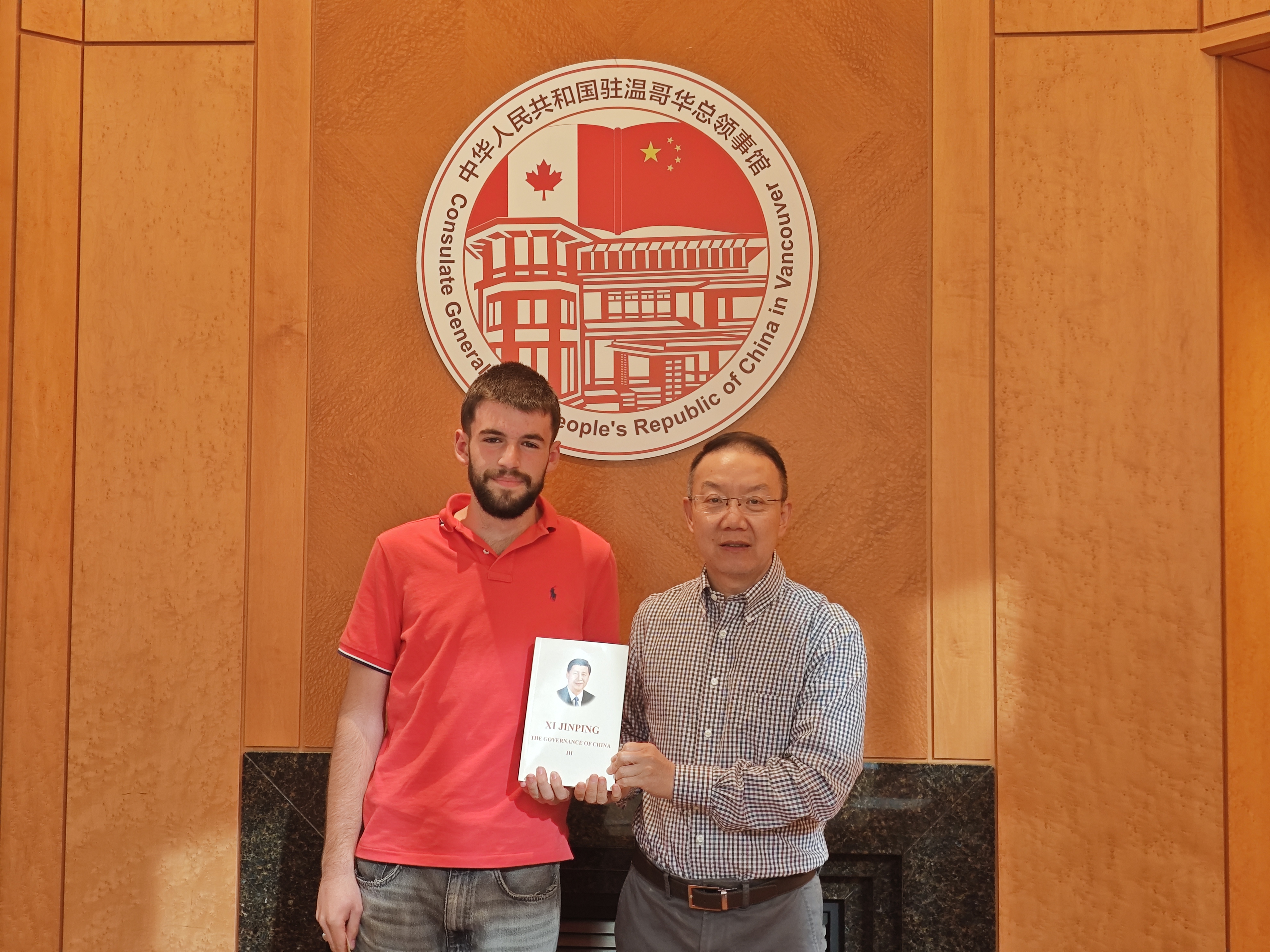
“I am currently going into grade 12 , while all my peers search for universities here in Canada, I look towards the East.”
Not long ago, the Chinese Consulate General in Vancouver received a remarkable email. It was written by Tomas Sablic, a student at Secondary School. Having just entered Grade 12, he has already begun seriously considering his university education and future. Unlike many of his classmates, he has set his sights on attending university in China, thousands of kilometres away.
“For post-secondary, I would like to study political science,” Tomas wrote in his email. Driven by a strong interest in politics, he began exploring the political systems and governance models of different countries at an early age and gradually turned his attention to China. He spoke candidly of his interest in and appreciation for China’s development achievements, believing that China’s development path and governance practices merit closer study. He also expressed a particular interest in learning more about Xi Jinping Thought on Socialism with Chinese Characteristics for a New Era and hoped to study political science at a Chinese university in the future. At the end of his email, he specifically asked: “Likewise, if there are any English books that I can buy here on Xi Jinping Thought, I would most certainly begin studying right away.”
Why would a Canadian secondarty school student take the initiative to write to the Chinese Consulate General? Why would he consider China as a destination for studying political science? Curious to learn more, we invited Tomas to visit the Consulate General.Accompanied by his mother, Tomas arrived as scheduled. Our conversation began with his school life and personal interests. He told us that reading was his greatest passion. Through extensive reading, he had gradually come to know more about China and developed a strong interest in its political system and national governance. He also told us that he would be taking Political Studies in the new school year to prepare for further study in the field.
When speaking about university and his future, Tomas was clear about his aspiration: he hoped to study in China and gain a deeper understanding of the country through learning and firsthand observation.
Tomas left a strong impression on us. Calm and composed, he expressed himself clearly and had given his interests and future a level of thoughtfulness beyond his years. We told him that books are important for understanding a country, but firsthand experience is even more valuable. What kind of country is China? Why has its development path proved successful? How does its political system operate? What is everyday life like for the Chinese people? These are questions worth exploring through his own observations, reflections and experiences.
We also introduced Tomas to Chinese universities and opportunities for studying in China and encouraged him to begin learning Chinese in preparation for studying there in the future. Before he left, we presented him with an English-language edition of Xi Jinping: The Governance of China. We hope the book will support his continued study and help him better understand China and its policies. We also hope that, one day, he will find his own answers as he pursues the path he chose when he wrote, “I look towards the East.”
The foundation of relations between countries lies in their peoples, and their future rests with the younger generation. How young people understand one another today will, to a great extent, shape the distance between nations tomorrow. When helping young people from other countries learn about China, the most important thing is not to draw conclusions for them, but to open a window, build a bridge, and encourage them to approach China, observe China and understand China for themselves.